How Do I Reduce Admin Work in My Health Services Business Without Losing Control?
Most health services businesses can automate three admin tasks immediately: appointment reminders, document collection, and compliance deadline tracking. Together, these typically consume 15 to 25 hours of staff time per week in a team of 5 to 15 people. Automating them does not remove your oversight. It removes the repetitive work, so your team focuses on the decisions only they can make.
The real problem
You didn't build a health services business to have your best people spend half their day chasing paperwork.
But here you are.
- Someone is sending appointment reminders by hand.
- Someone is emailing patients for the same intake documents every week.
- Someone is manually checking compliance deadlines on a spreadsheet and hoping nothing slips.
And every time you think about fixing it, the same question stops you: what if the system gets it wrong? What if automating something means losing visibility?
That concern is legitimate. Healthcare is not a business where mistakes are cheap. Patient data is sensitive. Compliance requirements are real and the consequences of missing them are serious. So the hesitation makes sense.
But here is what most health services founders discover once they actually look at their admin workflows: the risk of getting it wrong is not higher with automation. In most cases it is lower. Because a system does not forget to send the reminder. It does not lose the document request in an email thread. It does not miss the compliance deadline because someone was out sick that week.
The question is not whether to automate. It is which tasks are safe to automate and which ones still need your team.
What is safe to automate
These are the tasks that follow the same steps every time and do not require clinical judgment. Automating them removes repetitive work without removing human accountability from anything that matters.
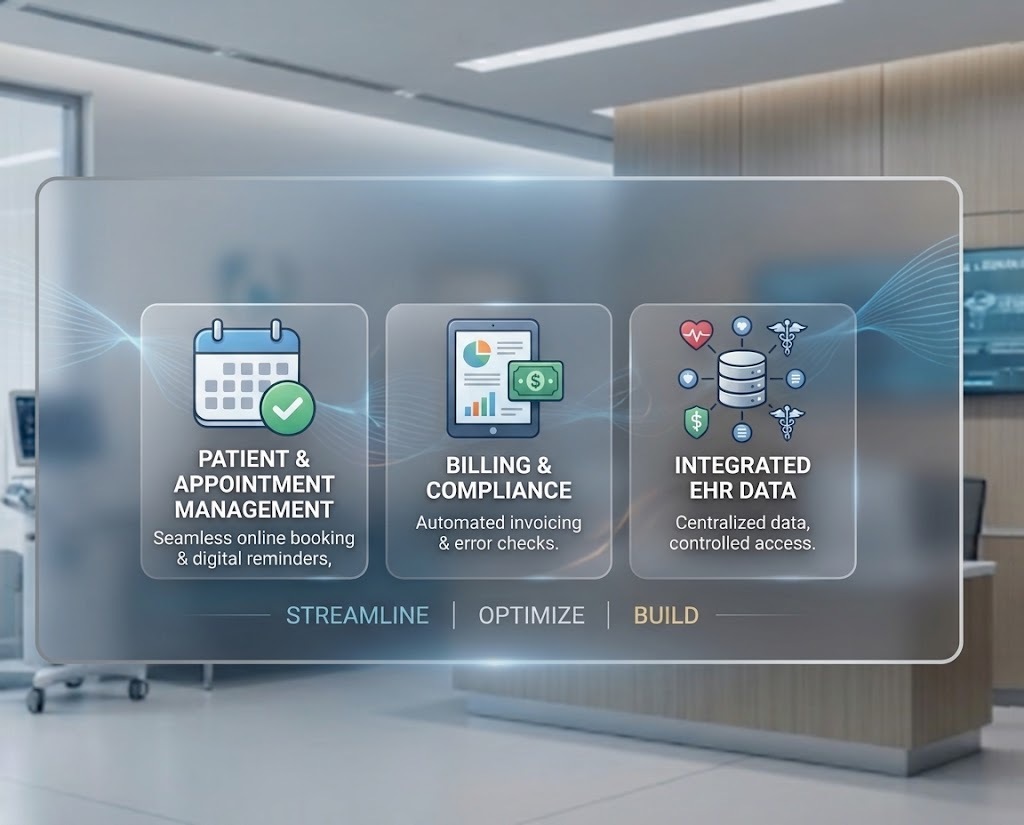
Appointment reminders and follow-up schedulingA patient books an appointment. A reminder goes out automatically 48 hours before. If they do not confirm, a follow-up goes out. If they cancel, the slot opens, and a waitlisted patient gets notified. Your admin staff stops managing this manually. The system handles it and flags anything that needs a human decision.
Document collection and patient intakeChasing patients for intake forms, consent documents, and insurance information is one of the highest volume manual tasks in most health services operations. An automated document request goes out at the right time, tracks whether it has been completed, sends a follow-up if it has not, and logs everything in the patient record. Your staff stops spending hours on the phone chasing paperwork and starts seeing complete records before the appointment even starts.
Compliance deadline tracking and reportingRegulatory deadlines, clinical documentation requirements, and compliance reports managed on spreadsheets with someone manually checking them each week is one of the most common problems we see in health services operations. A compliance dashboard centralizes all of it. Deadlines are flagged automatically. Reports are generated from approved data without anyone compiling them by hand. Every approval has a full audit trail so you always know who did what and when.
Billing reconciliation between disconnected systems Most health services businesses run a scheduling system, a billing platform, and a patient records system that do not talk to each other. Staff reconcile them manually every day. Connecting these systems means billing records update automatically when appointments are completed. The manual reconciliation stops, and the records stay accurate without anyone touching them.
What still needs your team
This is the part most automation conversations skip over, and it is the part founders in healthcare care about most.
A system can send the appointment reminder. It cannot decide whether a patient's symptoms need urgent attention before that appointment. A system can flag a compliance deadline. It cannot make the clinical decision that determines what goes in the report. A system can route a billing query. It cannot manage the relationship with a patient who has a complaint.
The work that requires judgment, clinical expertise, or human relationships still belongs to your team. Automation clears the space around that work so your team can actually do it instead of spending their day on tasks a system can handle just as well.
The founders who get the most out of this are the ones who treat automation as a way to make their team more effective, not as a way to reduce it.
What this means for your business
A health services operator with a team of 5 to 15 people is typically losing 15 to 25 hours of staff time per week to admin tasks that follow a repeatable pattern. At a loaded staff cost of $30 to $50 per hour, that is real money leaving your business every week in the form of time spent on work a system could handle.
A targeted automation for one specific workflow typically costs significantly less than one year of that lost time and a fraction of that annually to maintain. The hours recovered go back to patient-facing work. That is where your team creates value. That is where your business grows without your admin costs growing proportionally with it.
Real example
A healthcare compliance company we worked with was managing post-market clinical follow-up reporting across multiple sites entirely through spreadsheets and email.
Every report was compiled manually.
Approval workflows happened over email with no record of who approved what or when.
When a deadline was approaching, someone had to chase every site individually to find out where things stood.
We built a centralized compliance dashboard with role-based access for compliance managers, location leads, and report reviewers that tracks every approval, update, and deadline automatically without manual coordination between locations.
Deadlines are flagged before they become urgent. Every approval is tracked with a full revision history. The team now spends that time on the clinical work the compliance reports are actually about.
FAQ
Does automating admin mean we will need fewer people? Most health services businesses that automate admin use the recovered time to grow patient volume with the same team rather than cutting headcount. Your staff stop spending half their day on paperwork and start spending it on patients. The business grows without the admin cost growing at the same rate.
How do we maintain oversight if a system is handling tasks automatically?Every automation we build includes a review layer for anything that needs human confirmation, a notification when something falls outside the expected pattern, and a full audit trail so you can see exactly what the system did and when. You do not lose visibility. You get more of it because everything is logged rather than living in someone's email or memory.
Is patient data safe when admin tasks are automated?Yes, when it is built correctly. Every platform we build for health services is HIPAA-compliant from day one, with encrypted data storage and transmission, role-based access controls, and complete audit trails. Compliance is not something we add at the end. It is designed into the system from the start.
Where do we start if we want to automate something in our operation? Start with the task your admin staff mentions most when you ask them what slows their day down. Usually it is one of three things: chasing patients for documents, sending appointment reminders manually, or tracking compliance deadlines across a spreadsheet. Pick the highest-volume one, automate it, measure what changes, and expand from there. Most operations see the return within the first year.
Ready to cut the admin load?
Tell us which task your team keeps doing manually. We will tell you whether it is automatable, what it would take to remove it, and what your team could be doing with that time instead.