Key Takeaways
- Salesforce managed services are ongoing, expert-led programs that maintain, optimize, and evolve your Salesforce org after implementation, not a one-time project with a fixed end date.
- In 2026, Salesforce releases three major platform updates per year. Without a managed services partner reviewing each release, your customizations can break silently and your team misses new features that could automate hours of manual work.
- The most common reason Salesforce ROI disappoints is not the platform. It is the absence of ongoing optimization after go-live. Most orgs are operating at 30 to 40% of their potential capability within 12 months of launch.
- Salesforce managed services cost significantly less than a full-time Salesforce Administrator. A senior Salesforce Admin in Canada costs CAD $85,000 to $110,000 per year. A managed services retainer covering equivalent or broader expertise typically costs CAD $2,500 to $8,000 per month.
- You do not always need managed services. If your org has fewer than 50 users, minimal customization, and stable requirements, a part-time admin or on-demand support may be the right fit.
- Fantech Labs provides Salesforce managed services and admin support for Canadian businesses. Book a consultation at fantechlabs.ca/contact-us.
What are Salesforce managed services?
Salesforce managed services are ongoing, expert-led services that help businesses maintain, optimize, and evolve their Salesforce org after the initial implementation is complete. Unlike a Salesforce implementation project that has a defined end date, managed services are a continuous engagement where an external team acts as your Salesforce department handling admin work, system optimization, user support, release management, integration maintenance, and strategic CRM roadmap execution on a monthly retainer basis.
WHY SALESFORCE NEEDS ONGOING ATTENTION AFTER GO-LIVE
The go-live date feels like the finish line. After months of discovery sessions, design decisions, and user acceptance testing, your system is live and your team is trained. It is natural to think the hard work is done.
In the first few months after go-live, everything works as expected. Then reality sets in. Users develop workarounds instead of using the system as designed. Data quality begins to drift. Reports that were accurate at launch start producing questionable numbers. New business requirements emerge that nobody anticipated during implementation. And Salesforce itself releases an update that changes the behavior of a flow you built six months ago.
This is not a Salesforce problem. It is what happens to every complex business system that is not actively maintained. In 2026, Salesforce managed services are no longer just for support. They are strategic, proactive, and crucial for making Salesforce a true growth engine.
The Three Release Problem
.jpeg)
Salesforce releases three major platform updates every year: Spring, Summer, and Winter. Each release includes hundreds of changes, new features, modified behaviors, deprecated functions, and security updates. Without someone actively reviewing each release against your specific org configuration, two things happen consistently.
First, customizations break silently. A process builder replaced by Flow in one release, an API endpoint deprecated in the next, a permission set behavior that changed without announcement. These issues surface when something stops working, not before.
Second, your business misses features that would save hours of manual work every week. Einstein AI enhancements, new automation capabilities, improved reporting tools they ship three times a year and are invisible to teams without someone whose job is to evaluate them against your business requirements.
Data Decay
Salesforce data decays at approximately 30% per year without active governance. Contact records go stale. Duplicate accounts accumulate. Custom fields stop being populated because the process that populated them changed. Reporting becomes unreliable when the underlying data cannot be trusted.
Data governance deduplication, validation rules, required field enforcement, and regular data audits is an ongoing maintenance function, not a one-time cleanup.
WHAT SALESFORCE MANAGED SERVICES INCLUDE
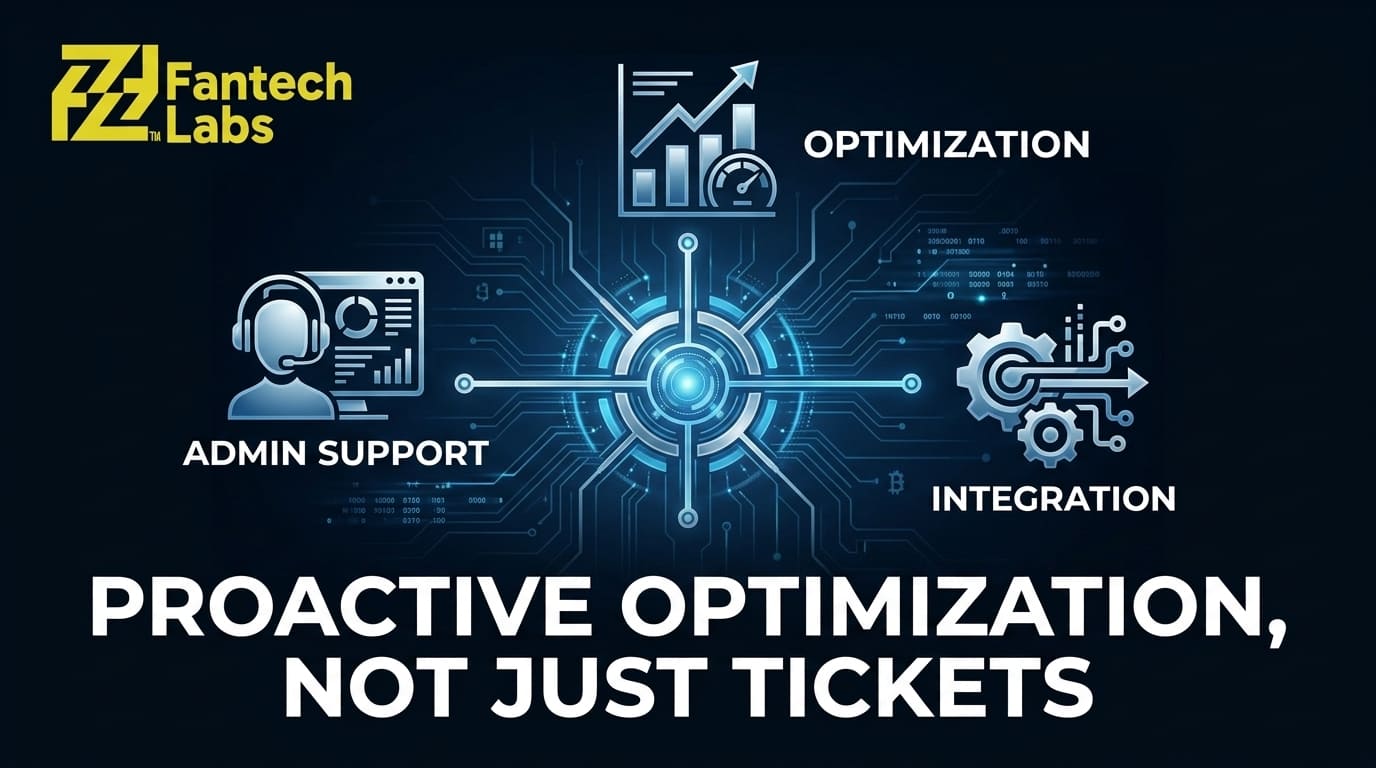
A Salesforce Managed Service Provider delivers ongoing support rather than assistance with one-time projects. In addition to resolving issues, they monitor your Salesforce system, perform regular health checks, and recommend continuous improvements. An MSP may automate manual sales processes or periodically clean your data.
The scope of a managed services engagement typically covers six areas.
Salesforce Admin Support
Day-to-day Salesforce administration covers user management, permission sets, profile configuration, field and object creation, page layout modifications, report and dashboard builds, and basic automation updates. For most organizations, this is the core of what they need on an ongoing basis: someone who can handle the steady stream of admin requests without a weeks-long delay.
Release Management
Three times per year, a Salesforce release reviewer goes through the release notes, identifies changes that affect your org's configuration, tests impacts in a sandbox environment, and communicates what is changing and why to your team. Without this function, release impacts are discovered in production by frustrated users.
System Optimization
Optimization is the work that moves your org from functioning to performing. This includes flow and automation cleanup, removal of technical debt accumulated during implementation, performance improvements for slow-loading pages and reports, and identifying capabilities your team is not using that address current pain points.
User Training and Enablement
New hires need Salesforce training. Existing users need refreshers when processes change. Teams adopting new Salesforce features need guided enablement. Managed services partners handle ongoing training so adoption rates stay high and workarounds stay low.
Integration Maintenance
Every integration your Salesforce org has with external systems ERP, marketing automation, customer support platforms, accounting software requires ongoing maintenance as those systems update their APIs and data models. Fantech Labs builds and maintains Salesforce integrations for Canadian businesses. Learn more at fantechlabs.ca/services.
Strategic CRM Roadmap
The highest-value managed services work is strategic: reviewing your Salesforce org against your current business goals, identifying where the platform is falling short, prioritizing enhancements, and planning the roadmap for the next 6 to 12 months. This is the difference between a managed services partner and an admin helpdesk.
SIGNS YOU NEED SALESFORCE MANAGED SERVICES
Not every business needs a managed services engagement. But several signals reliably indicate that ongoing support would deliver meaningful value.
Your Team Has Accumulated Salesforce Workarounds
When users build processes outside of Salesforce spreadsheets for tracking that should be in Salesforce, email chains for approvals that should be automated flows, manual exports for reports that should run automatically it signals that the system is not keeping up with business needs. Workarounds compound. Each one reduces the data quality and adoption rate that makes Salesforce valuable.
Your Salesforce Admin Left
The departure of an internal Salesforce Admin is one of the most common triggers for a managed services conversation. Salesforce knowledge is concentrated in the person who built and maintained the org. When that person leaves, the organization loses the institutional knowledge of why things are configured the way they are, how to make changes safely, and what is on the roadmap.
A managed services partner absorbs this risk by maintaining documented knowledge of your org configuration that does not leave when a person does.
Your Reports Cannot Be Trusted
When sales leaders stop relying on Salesforce pipeline reports because the data does not match reality, Salesforce has effectively failed its primary function. Data quality problems are almost always fixable, but they require dedicated ongoing effort not a one-time cleanup.
You Are Not Using Features You Are Paying For
Most Salesforce customers use a fraction of the capabilities included in their license. Einstein Analytics sitting unused, Flow automation replacing only a handful of the manual processes it could eliminate, collaborative forecasting configured but not adopted, these represent paid capabilities producing no return. A managed services partner's job is to close this gap systematically.
Your Business Is Growing or Changing
A Salesforce org designed for 30 users behaves differently at 150 users. A process built for one sales team breaks when a second sales team with different workflows is added. Growth and organizational change create a continuous demand for Salesforce configuration updates that exceeds what occasional project-based support can handle.
SALESFORCE MANAGED SERVICES VS HIRING A FULL-TIME ADMIN
This is the most practical question most Canadian businesses face when evaluating managed services.
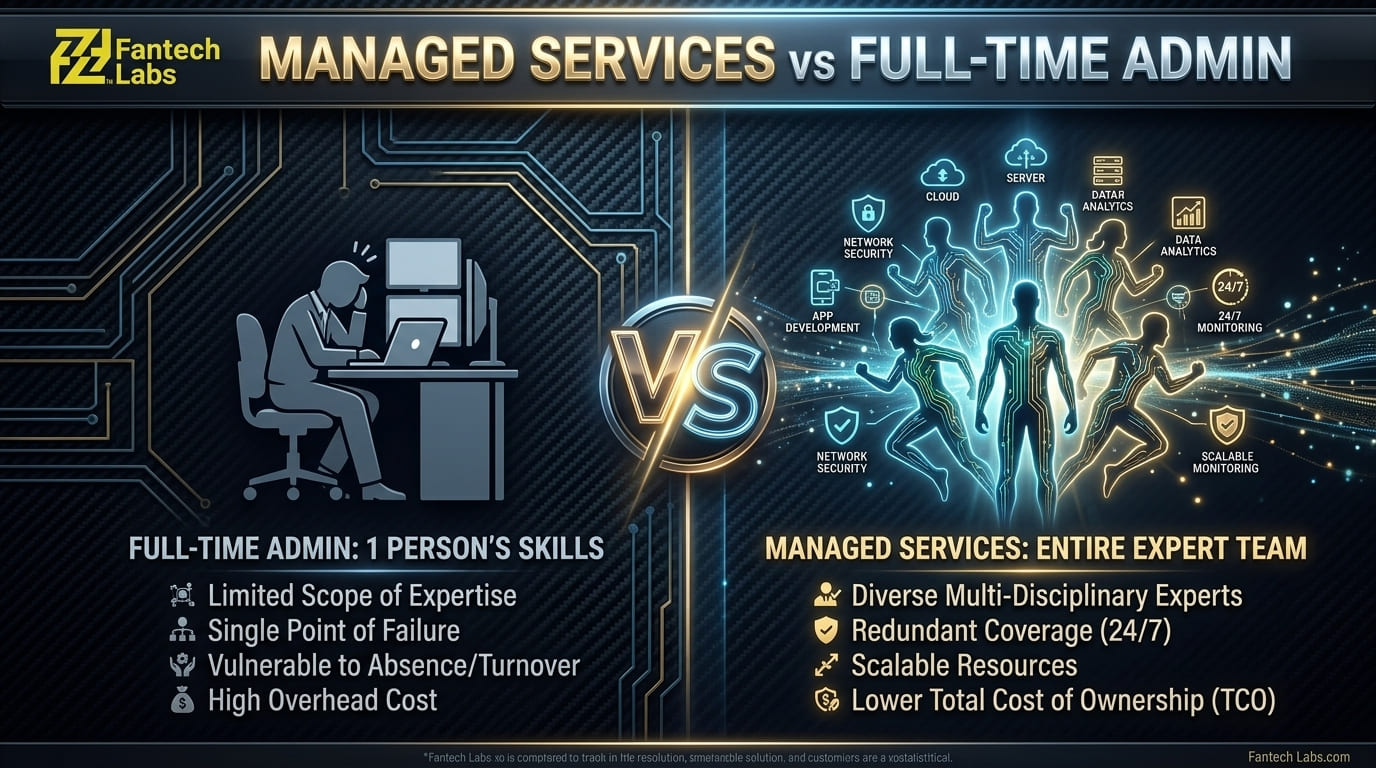
A senior Salesforce Administrator in Canada costs CAD $85,000 to $110,000 per year in base salary plus benefits, recruitment costs, and the ongoing risk of turnover. A mid-level admin costs CAD $65,000 to $85,000. In both cases, you are getting one person's knowledge and availability.
A good managed services partner should act as an extension of your internal team, not just a ticket-resolution vendor. A managed services retainer from Fantech Labs covering equivalent or broader Salesforce expertise typically costs CAD $2,500 to $8,000 per month depending on scope. That is CAD $30,000 to $96,000 per year with access to a team that includes developers, administrators, integration specialists, and strategic consultants rather than a single administrator.
The managed services model wins on breadth. When your business needs a new integration built, a managed services partner has the developer available. When you need complex automation, the flow developer is there. When you need strategic advice on your Salesforce roadmap, the architect is accessible. A single admin cannot provide all of these capabilities.
The in-house model wins on availability and organizational context. A dedicated internal admin develops deep familiarity with your specific business and is available throughout the business day for ad hoc requests. For organizations with complex, high-volume daily Salesforce needs and the budget for a senior admin, the in-house model remains valid.
Many Canadian businesses use a hybrid model: a part-time internal Salesforce owner for day-to-day user support, combined with a managed services partner for optimization, development, integration maintenance, and strategic work.
SALESFORCE SUPPORT PLAN MODELS: WHICH FITS YOUR BUSINESS
Common managed services pricing models and when they fit are as follows. A retainer provides reserved hours each month with SLAs and a predictable cadence for enhancements and support. On-demand or pay-as-you-use provides elastic capacity without long commitments, ideal for fluctuating demand. A hybrid team model provides a core allocation plus a flexible enhancement pool to handle spikes. Outcome-oriented fees are aligned to KPIs or milestones when objectives are well-defined.
Monthly Retainer
A monthly retainer reserves a defined number of hours per month at a fixed fee. The managed services partner commits to response time SLAs and a proactive engagement model not just waiting for tickets. Best for organizations with consistent ongoing Salesforce needs and a preference for predictable monthly costs.
Typical retainer tiers from Fantech Labs range from CAD $2,500 per month for basic admin support covering up to 20 hours, to CAD $5,000 per month for comprehensive support including optimization and integration maintenance, to CAD $8,000 per month for strategic managed services including roadmap development, developer support, and priority SLAs.
On-Demand Support
On-demand support provides access to Salesforce expertise without a monthly commitment. You purchase a block of hours and draw on them as needed. Best for organizations with variable or unpredictable Salesforce needs, or those transitioning from a recent implementation who are not yet sure what their ongoing support volume will be.
Project-Based with Transition to Managed Services
Best practice is to execute the big change as a project, then transition to managed services for ongoing growth. If your organization is preparing for a major CRM rollout or modernization before moving into managed services, the right sequence is a formal implementation project followed by a managed services engagement that maintains and evolves what was built.
Fantech Labs supports both the implementation and the ongoing managed services phases. Learn more at fantechlabs.ca/contact-us.
WHAT FANTECH LABS SALESFORCE MANAGED SERVICES COVER
Fantech Labs provides Salesforce managed services and admin support for Canadian businesses across healthcare, fintech, construction, and enterprise sectors. Our senior developer Hassan Ali brings 8 years of Salesforce and integration development experience to every managed services engagement.
Our managed services scope includes Salesforce admin support for day-to-day requests, release management and impact assessment for each of the three annual Salesforce releases, integration maintenance for existing connections between Salesforce and other business systems, flow and automation optimization, data governance and deduplication, user training for new hires and process changes, and strategic CRM roadmap development aligned to your business goals.
Every managed services engagement from Fantech Labs includes a monthly reporting summary covering work completed, system health indicators, and recommended priorities for the following month. You always know what we did and why.
PIPEDA compliance is built into every Canadian Salesforce managed services engagement. Any changes to data handling, user permissions, or integration flows are evaluated against PIPEDA requirements before implementation. Learn more about our approach at fantechlabs.ca/services.
COMPARE OPTIONS WITH FANTECH LABS
Step 1: Book a free consultation at fantechlabs.ca/contact-us to discuss your current Salesforce org and support needs.
Step 2: We conduct a Salesforce org health check to identify your current configuration gaps, data quality issues, and unused capabilities.
Step 3: We recommend the right support model, monthly retainer, on-demand hours, or a hybrid based on your actual usage patterns and business requirements.
Step 4: We produce a documented onboarding summary of your org configuration so knowledge is captured from the first month of engagement.
Step 5: Monthly work proceeds with transparent reporting and proactive recommendations, not just reactive ticket resolution.
Frequently Asked Questions
What are Salesforce managed services?
Salesforce managed services are ongoing, expert-led services that maintain, optimize, and evolve your Salesforce org after implementation. A managed services provider handles admin work, release management, user support, integration maintenance, data governance, and strategic CRM roadmap development on a continuous basis.
How much do Salesforce managed services cost in Canada?
Monthly retainer pricing for Salesforce managed services in Canada typically ranges from CAD $2,500 for basic admin support to CAD $8,000 or more for comprehensive strategic managed services. This compares favorably to a full-time Salesforce Admin at CAD $65,000 to $110,000 per year, especially when factoring in the broader team expertise a managed services partner provides.
What is the difference between Salesforce managed services and Salesforce professional services?
Salesforce professional services cover a fixed scope with a defined end date implementation, migration, or a specific project. Salesforce managed services are ongoing, with no fixed end date, covering the continuous admin, optimization, and evolution work that every Salesforce org requires after go-live.
Do I still need an internal Salesforce admin if I use managed services?
It depends on your org complexity and daily request volume. Many organizations keep a lean internal Salesforce owner for immediate user support and organizational context, combined with a managed services partner for optimization, development, and strategic work. Others with lower daily Salesforce needs rely entirely on their managed services partner.
How does Fantech Labs handle PIPEDA compliance in Salesforce managed services?
Any changes to data handling, user permissions, or integration flows in your Salesforce org are evaluated against PIPEDA requirements before implementation. Fantech Labs builds PIPEDA compliance into every managed services engagement for Canadian businesses.
When is the right time to start Salesforce managed services?
The best time is immediately after go-live while your org configuration is fresh and institutional knowledge is high. The second-best time is when you notice the symptoms that indicate Salesforce is not being actively maintained: accumulating workarounds, data quality drift, user adoption declining, or your internal admin departing.
SUMMARY: DO YOU NEED SALESFORCE MANAGED SERVICES IN 2026?
First, if your Salesforce org has been live for more than 6 months without dedicated ongoing support, it is almost certainly operating below its potential. An org health check will confirm this in hours.
Second, managed services cost less than a full-time admin while providing access to broader expertise including developers, integration specialists, and strategic architects.
Third, three Salesforce releases per year create ongoing maintenance obligations that cannot be handled on a break-fix basis. Release management alone justifies a managed services engagement for most organizations.
Fourth, data quality is a continuous maintenance function. A one-time cleanup without ongoing governance solves the problem for 90 days and then the problem returns.
Fifth, the right managed services model depends on your org complexity, daily request volume, and whether you have an internal Salesforce owner. Fantech Labs can recommend the right structure after a brief org assessment.
Book Your Free Salesforce Managed Services Consultation at Fantech Labs →
Conclusion
Salesforce is not a one-time implementation. It is a platform that requires continuous investment to deliver continuous returns. The organizations that get the most from Salesforce in 2026 are not the ones with the largest initial implementation budgets. They are the ones with a disciplined, proactive approach to ongoing optimization, data governance, and platform evolution. Fantech Labs provides that approach for Canadian businesses as a trusted managed services partner with 15 years of development experience and direct Salesforce expertise.
Why Trust Fantech Labs
At Fantech Labs, we build software that solves real business problems for Canadian companies. Our senior developers are directly involved in every project, our case studies are published with real client names, and our post-launch support is structured rather than ad hoc.
Disclaimer: Information provided is for educational purposes only. Salesforce platform capabilities, pricing, and managed services scope are subject to change. Always consult a qualified Salesforce professional before making CRM investment decisions.
Author Bio
Saim Muneer | Senior CRM Architect & Salesforce Expert Saim Muneer is a Senior Developer and CRM Architect at Fantech Labs, specializing in Salesforce administration, custom integrations, and platform optimization. He helps Canadian businesses eliminate technical debt and maximize their CRM ROI through proactive, PIPEDA-compliant managed services. Saim’s expertise ensures that enterprise workflows run seamlessly and scale securely with business growth.