
Key Takeaways
- Mobile app development in Canada costs between $15,000 and $300,000+ CAD in 2026, with most startup MVPs landing between $25,000 and $80,000.
- Developer rates in Calgary and Montreal run $90 to $110 CAD per hour, compared to $120 to $150 per hour in Toronto and Vancouver, without compromising quality.
- Most new business owners should build a Minimum Viable Product first, not the full app, so real user feedback shapes the product before the majority of the budget is spent.
- Canadian-Controlled Private Corporations (CCPCs) can claim up to 35% of eligible development costs back through the SR&ED federal tax credit, which increased its expenditure limit from $3 million to $6 million in 2026.
- Cross-platform development using Flutter or React Native reduces build cost by 30 to 50% compared to building two separate native apps, and is the right default for most startup budgets.
- Over 33 million Canadians use smartphones. A mobile-first strategy is no longer optional for businesses competing for customer attention in 2026.
- Annual maintenance costs 15 to 25% of the initial build cost. Budgeting for this from day one is the most commonly missed step in startup app planning.
Why New Business Owners Are Prioritizing Mobile Apps in 2026
Mobile apps are no longer just for large companies with enterprise budgets. In 2026, a well-built mobile app is one of the most practical tools a new Canadian business can have. Canada has over 33 million smartphone users, and the digital transformation market is projected to grow by over 20% annually through 2030. Customers expect to interact with businesses through their phones, whether that means booking a service, tracking an order, or accessing their account.
For new business owners, the decision to build an app is also a customer acquisition decision. An app on someone's phone is a direct channel that bypasses social media algorithms, email open rates, and ad spend. Push notifications, personalized offers, and frictionless purchases all become available the moment a customer installs your app. That is why Canadian startups across food delivery, home services, healthcare, and logistics are launching with mobile apps as a core part of their go-to-market strategy, not an afterthought added later.
What Does Mobile App Development Actually Cost in Canada in 2026?
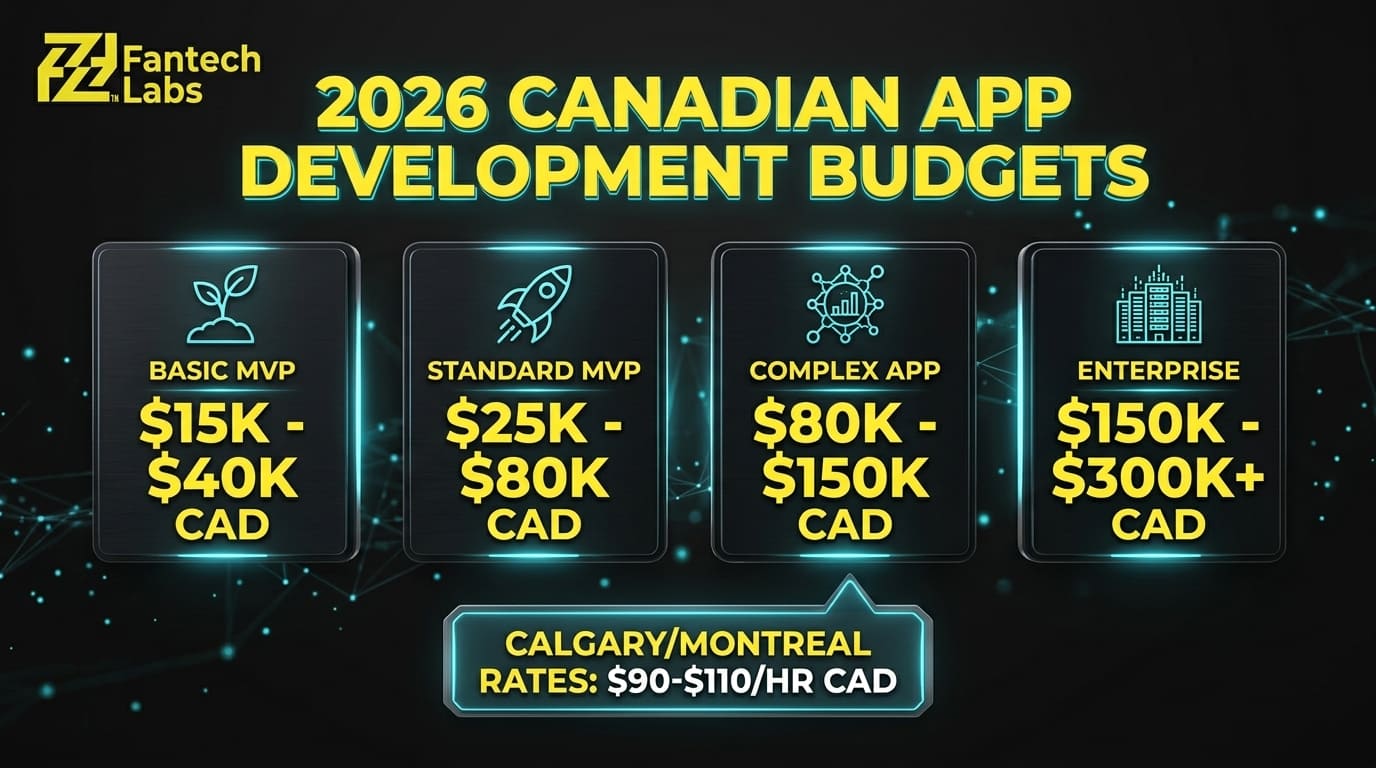
Mobile app development in Canada costs between $15,000 and $250,000+ CAD in 2026. Most startup-friendly MVPs begin at around $25,000 CAD, while enterprise apps with AI, fintech, or healthcare features can exceed $300,000.
The wide range exists because app complexity drives cost more than any other single factor. Here is how the investment breaks down across the most common project types:
| App Type | What Is Included | Typical CAD Range (2026) |
|---|---|---|
| MVP / Prototype | Core features only, one platform, basic UI | $15,000 to $35,000 |
| Simple business app | Booking, payments, push notifications, CMS | $25,000 to $60,000 |
| Mid-complexity app | User accounts, API integrations, two platforms | $60,000 to $120,000 |
| Complex app | Custom logic, AI features, real-time data, backend | $120,000 to $300,000+ |
| Enterprise app | Multi-system integration, compliance, high security | $300,000+ |
Developer rates vary significantly by city. In Toronto and Vancouver, expect to pay $120 to $150 CAD per hour for reputable developers. In Calgary and Montreal, rates run $90 to $110 per hour - a meaningful difference on a project that runs 500 to 2,000 hours of development time.
Plan to budget 15 to 25% of your initial build cost annually for ongoing operations including maintenance updates, security patches, server costs, and App Store fees. This recurring cost is the most commonly overlooked line item in startup app budgets.
Should New Business Owners Build Native or Cross-Platform?
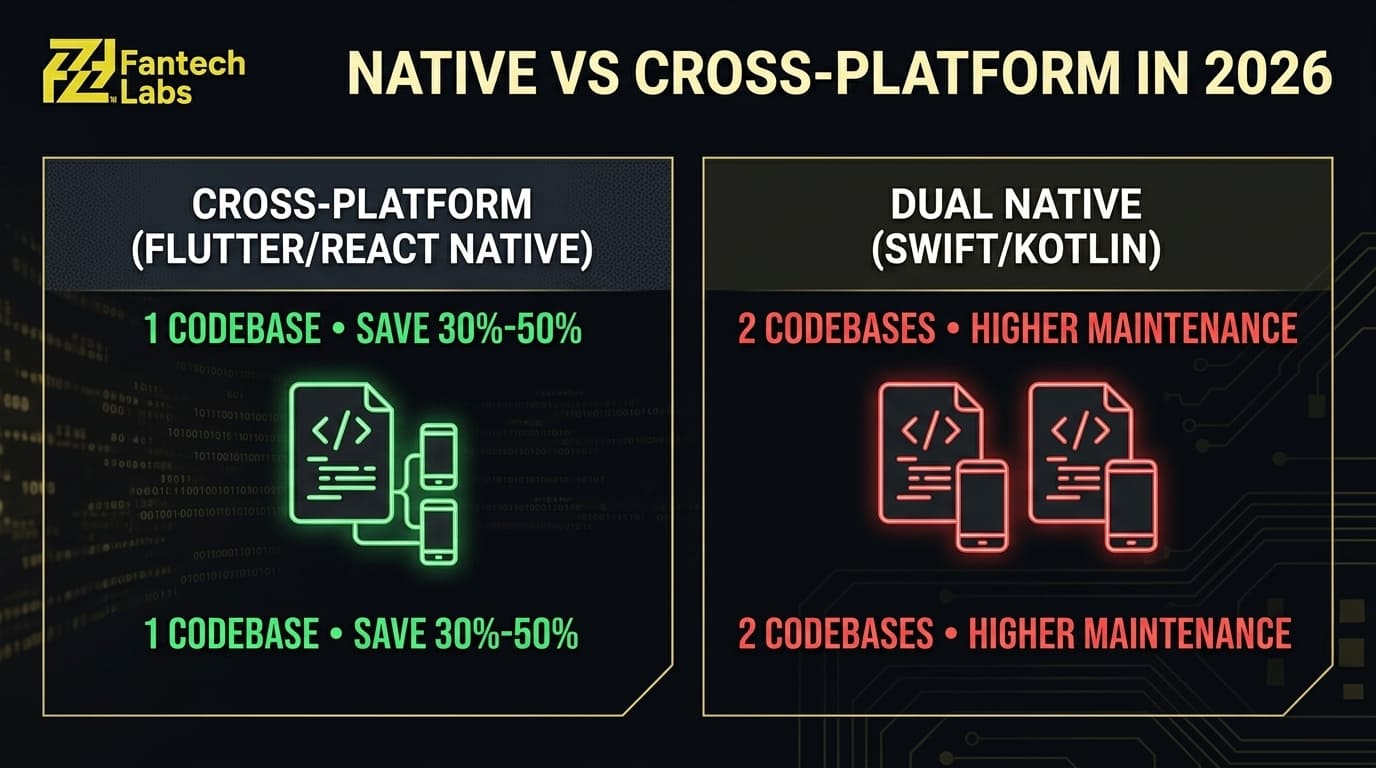
This is the most consequential technical decision most new business owners will make before a single line of code is written. The answer shapes the budget, the timeline, the developer talent pool, and the long-term maintenance cost.
| Factor | Native iOS + Android | Cross-Platform (Flutter / React Native) |
|---|---|---|
| Cost | 1.6x to 2.0x baseline | 1.0x baseline |
| Codebase | Two separate codebases | One shared codebase |
| Performance | Structurally optimal | Near-native for 95% of apps |
| Time to launch | Longer | 30 to 50% faster |
| Talent pool | Smaller, more specialized | Larger, more accessible |
| Best for | Deep hardware integration | Most startup use cases |
For most new business owners, cross-platform development using Flutter or React Native is the right starting point. It cuts budget by 30 to 50% compared to building two separate native apps, reaches iOS and Android users simultaneously, and allows a lean team to move faster. Native development wins only when the app requires deep platform-specific hardware access, such as LiDAR, CarPlay, or custom Bluetooth peripherals.
Fantech Labs builds cross-platform apps using Flutter and React Native for Canadian businesses, with native modules added only where the app's core functionality genuinely requires them.
What Is an MVP and Why Should New Business Owners Start There?
An MVP, or Minimum Viable Product, is the smallest version of your app that delivers enough value for real users to use it and give you feedback. It is not a half-finished app. It is a deliberately scoped app that solves one problem well, ships fast, and generates the real-world data that shapes every subsequent development decision.
New business owners who skip the MVP stage and build the full product from a specification document consistently run into the same problem: they spend the entire budget building features users do not want and underbuilding the features users care about most. The MVP approach inverts this. You launch, you learn, and you build what the market actually validates.
A well-scoped MVP for a Canadian startup in 2026 typically includes user authentication, the core primary action (booking, purchase, search, or submission), push notifications, and basic analytics. Everything else is post-launch scope based on what real users tell you.
How Does the SR&ED Tax Credit Reduce Your App Development Cost in Canada?
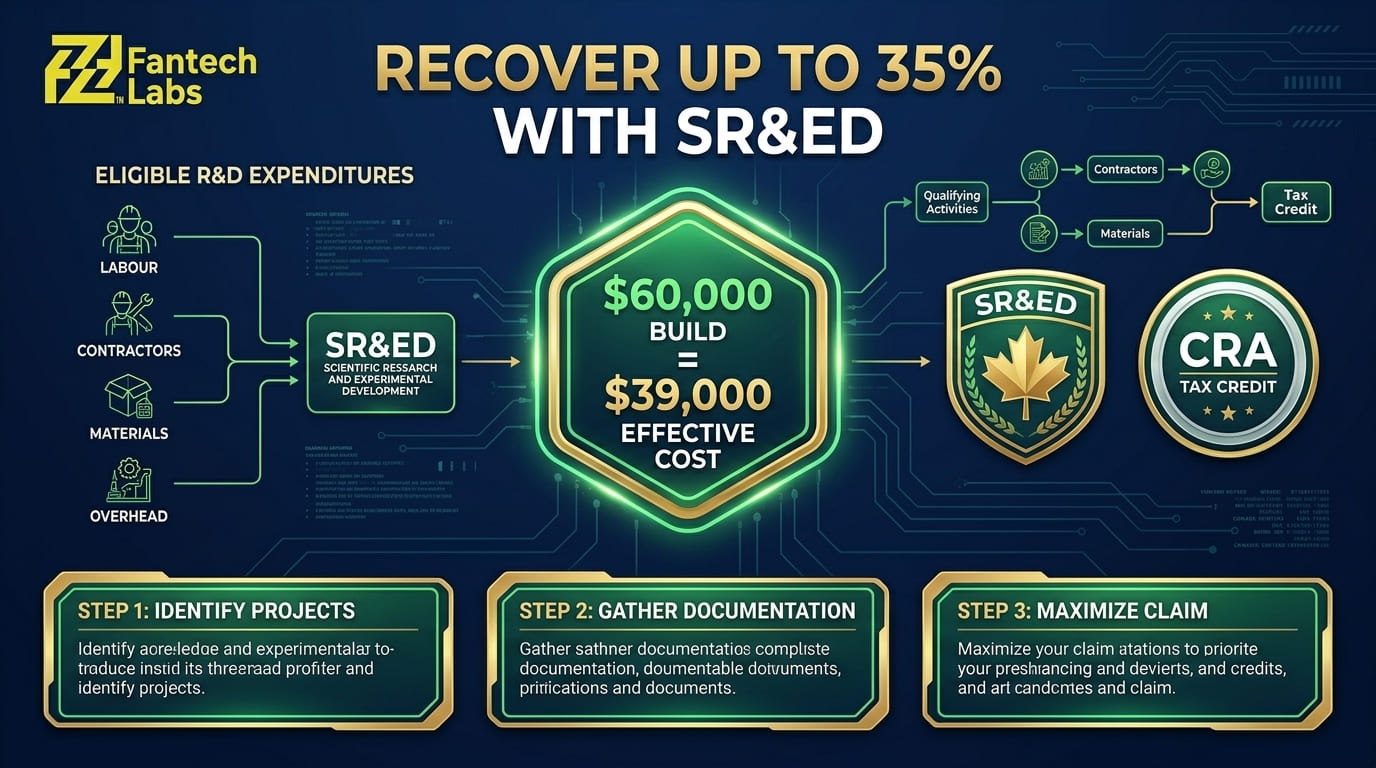
The SR&ED (Scientific Research and Experimental Development) program is the federal government's largest R&D tax incentive, and it applies directly to mobile app development for many Canadian startups. The SR&ED program lets Canadian startups recover up to 35 cents of every dollar spent on R&D. For Canadian-Controlled Private Corporations (CCPCs), the SR&ED credit is partially or fully refundable, meaning you receive cash back from the CRA even if your company has no taxable income.
In 2026, the annual limit for the 35% refundable credit for CCPCs rose from $3 million to $6 million, meaning a CCPC can now claim up to $2.1 million in refundable credits per year.
In practical terms: a $60,000 mobile app build can effectively cost $39,000 to $42,000 after federal and Ontario SR&ED credits are applied.
Your app development likely qualifies for SR&ED if it involves:
- Solving a technical problem where the answer was not available in existing documentation
- Building custom algorithms, data processing logic, or ML components
- Developing novel integration approaches between systems
- Experimenting with architecture decisions where the outcome was genuinely uncertain
Your development team or a specialized SR&ED consultant can identify eligible work and prepare the claim. The deadline to file is 18 months after the end of the fiscal year in which the work was done.
What Technologies Does a Canadian Mobile App Use in 2026?
Technology choices made at the start of a project determine what the app can do, how maintainable it is in two years, and how easy it is to integrate with the business systems you already run.
| Layer | Technologies | Notes |
|---|---|---|
| Cross-platform framework | Flutter, React Native | Flutter for design-heavy apps, React Native for JS teams |
| Native iOS | Swift, SwiftUI | Required for Apple Watch, CarPlay, ARKit |
| Native Android | Kotlin, Jetpack Compose | Required for Android Auto, advanced hardware |
| Backend | Node.js, Firebase, AWS Amplify | Firebase for fast MVPs, Node.js for custom logic |
| Database | PostgreSQL, MongoDB, Firebase Firestore | Depends on data structure and query needs |
| Authentication | Firebase Auth, Auth0, Supabase | OAuth, social login, biometric |
| Payments | Stripe, Square | Both have strong Canadian support |
| Push notifications | Firebase Cloud Messaging | Works across iOS and Android |
| Analytics | Mixpanel, Amplitude, Firebase Analytics | Event tracking, funnel analysis |
The technology stack should follow the product requirements, not the other way around. A startup building a simple booking app does not need the same infrastructure as a fintech platform handling thousands of daily transactions. Fantech Labs scopes the right stack for the project's actual requirements and growth trajectory before any code is written.
App Launch Checklist for Canadian New Business Owners
New business owners often focus so heavily on the build phase that the launch phase catches them unprepared. A poorly managed launch loses users in the first 48 hours that a well-prepared launch retains for months. Use this checklist before your app goes live:
Before Development Starts
- Define your core user and the single primary problem your app solves for them
- Scope your MVP features and lock the list before development begins
- Choose your platforms (iOS only, Android only, or both)
- Select your development team and confirm they have Canadian references
- Confirm SR&ED eligibility with your accountant or an SR&ED consultant
- Set your App Store developer accounts (Apple Developer Program: USD $99/year, Google Play: USD $25 one-time)
During Development
- Review design mockups before any development begins
- Test on real devices at every stage, not just simulators
- Confirm App Store guidelines compliance early, not at submission
- Document technical decisions for SR&ED purposes as work progresses
- Plan your backend infrastructure for launch-day traffic, not just test traffic
Before Launch
- Complete QA testing across all target devices and OS versions
- Submit to App Store and Google Play at least 2 to 4 weeks before your launch date (Apple reviews take 1 to 3 days on average but can take longer for first submissions)
- Set up crash reporting and analytics before day one
- Prepare your App Store listing: screenshots, description, keywords, and preview video
- Test your onboarding flow with 5 to 10 real users who have never seen the app
Launch Week
- Send launch communications to your existing audience before the public announcement
- Monitor crash reports and user reviews daily
- Respond to App Store reviews within 24 hours
- Track your core funnel: install, onboarding completion, first key action
- Have a hotfix process ready for critical bugs
Post-Launch (First 90 Days)
- Review analytics weekly and identify where users drop off
- Interview your first 20 active users to understand what they value most
- Prioritize your next development sprint based on real user behavior, not original assumptions
- File your SR&ED claim documentation for the development period
- Budget and schedule your first major update based on user feedback
What to Look for in a Mobile App Development Partner in Canada
Choosing the right development team is the decision that has the most impact on whether your app launches successfully and continues to improve after launch.
| Factor | What to Look For |
|---|---|
| Canadian references | Ask for clients in Canada you can call directly |
| Portfolio relevance | Have they built apps in your industry or complexity tier? |
| MVP experience | Do they scope MVPs or push full builds? |
| Post-launch support | Is maintenance included or contracted separately? |
| SR&ED support | Can they help document eligible work for your claim? |
| Pricing transparency | Itemized proposals, not lump sums |
| Communication | Canadian business hours availability, response within 24 hours |
Offshore teams can deliver code at lower hourly rates. The consistent issue Canadian new business owners report is communication friction, time zone delays, and gaps in familiarity with Canadian App Store requirements, PIPEDA data privacy obligations, and payment processing regulations. For a first-time app, having a team that is accountable, reachable, and familiar with the Canadian market is worth the difference in hourly rate.
Frequently Asked Questions
How much does it cost to build a mobile app for a new business in Canada?
Mobile app development in Canada in 2026 typically ranges from $15,000 to $250,000+ CAD. Most startup-friendly MVPs begin at around $25,000 CAD. The right starting point for most new business owners is an MVP scoped to the core features only, which keeps the initial investment manageable and ensures the full build is shaped by real user feedback rather than assumptions.
How long does it take to build a first mobile app in Canada?
A properly scoped MVP for a new Canadian business typically takes 8 to 16 weeks from kickoff to App Store submission. A mid-complexity app with user accounts, payment integration, and a backend takes 16 to 24 weeks. Enterprise apps with compliance requirements, AI features, or multi-system integration take 6 to 12 months. These timelines assume the client provides branding assets and content on schedule and responds to design reviews within agreed timeframes.
Can a new Canadian business claim SR&ED tax credits for app development?
Yes. SR&ED lets Canadian startups recover up to 35 cents of every dollar spent on qualifying R&D, including developer salaries. CCPCs receive cash refunds even if the company has no taxable income. Your app work likely qualifies if it involves solving technical problems that were not answerable through standard practice. Speak with an SR&ED consultant before development begins so eligible work is documented properly from the start.
Should a new business owner build for iOS or Android first?
For most Canadian new business owners targeting a general consumer audience, cross-platform development using Flutter or React Native delivers both iOS and Android from one codebase at 30 to 50% lower cost than building separately. If your audience skews toward a specific platform, such as an enterprise business tool where corporate devices are often Android, or a premium consumer product where early adopters often use iPhone, that may influence the decision. An experienced development team will recommend the approach that fits your specific audience and budget.
What is the biggest mistake new business owners make when building their first app?
The most common mistake is building the full product before getting any user feedback. New business owners who skip the MVP stage typically spend their entire budget on features users do not want and underinvest in the features that drive retention. The second most common mistake is not budgeting for post-launch maintenance, which costs 15 to 25% of the initial build cost annually and cannot be skipped without the app degrading in performance and compatibility over time.
About Fantech Labs: Fantech Labs is a Calgary-based mobile app and IT development company serving new and growing businesses across Canada. We build cross-platform mobile apps, custom web applications, AI automations, and system integrations for businesses that need technology that works from day one.