Digital Marketing Trends 2026: What Businesses Need to Know
Explore the key digital marketing trends shaping 2026, including AI, automation, and data-driven strategies for scalable growth.
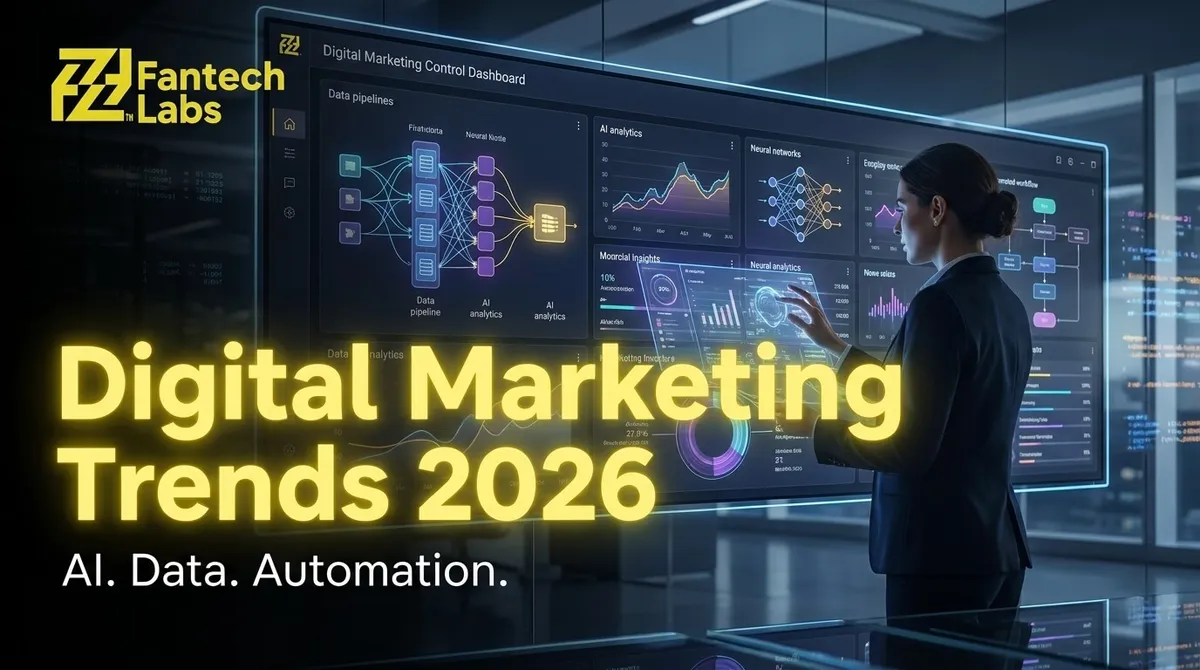
What Digital Marketing Trends Will Define 2026 and Why Should Businesses Care?
Digital marketing in 2026 is no longer about choosing channels.
It is about building systems that connect data, automation, and customer intent into one continuous experience.
The businesses that adapt are not just running campaigns. They are building Systems that scale.
In simple terms:
➜ Digital marketing trends in 2026 are shifting from execution to system-driven growth.
For companies operating in competitive markets, ignoring these changes means slower growth, higher acquisition costs, and fragmented customer journeys.
Why Digital Marketing Is Changing Faster Than Before
.jpeg)
Marketing is evolving because technology has changed.
Key shifts include:
- AI-driven search replacing traditional discovery
- users expecting instant, personalized responses
- increased competition across digital channels
- tighter integration between marketing, sales, and operations
This means traditional strategies like isolated SEO, ads, or email campaigns are no longer enough.
Insight:
Marketing is no longer a separate function. It is becoming part of how businesses operate.
Trend 1: AI-Powered Search Is Reshaping Visibility
Search is no longer just about ranking on search engines.
Instead of browsing multiple pages, users rely on:
- AI-generated answers
- conversational search interfaces
- summarized results
This affects how content is discovered.
What This Means for Businesses
To stay visible, businesses need to:
- Answer questions clearly and directly
- Structure content with headings and logical flow
- Build authority through accurate and useful information
➜ Important shift: Visibility now depends on whether your content can be understood and selected by AI systems, not just indexed.
Trend 2: Content Must Be Built for Humans and AI Systems
Content strategies are evolving beyond keyword targeting.
In 2026, effective content needs to:
- Answer specific questions clearly
- provide structured information
- demonstrate expertise and credibility
What Is Changing
- long-form content is becoming more structured
- Clarity is more important than length
- Repetition and keyword stuffing reduce trust and visibility
Insight:
The goal is not to include keywords. The goal is to provide clear, valuable information that AI systems can interpret and surface.
Trend 3: First-Party Data Is Becoming a Core Growth Asset
.jpeg)
With increasing privacy regulations and reduced third-party tracking, businesses are shifting toward first-party data.
This includes:
- customer interactions
- behavior tracking
- direct engagement data
Why This Matters
First-party data allows businesses to:
- understand customer behavior more accurately
- personalize communication
- reduce dependency on external platforms
Insight:
Data ownership is becoming a competitive advantage, not just a technical detail.
Trend 4: Automation Is Becoming Essential
Manual marketing processes cannot scale efficiently.
Businesses are increasingly relying on:
- workflow automation
- AI-driven decision systems
- integrated marketing platforms
Impact
Automation helps:
- reduce response time
- improve consistency
- manage large volumes of leads and interactions
Insight:
Automation is no longer about saving time. It is about maintaining performance at scale.
Trend 5: Integrated Marketing Systems Are Replacing Isolated Tools
Many businesses still rely on multiple disconnected tools.
This creates:
- data silos
- inconsistent customer experiences
- operational inefficiencies
The Shift
Businesses are moving toward:
- unified platforms
- connected workflows
- centralized data systems
Insight:
Growth is no longer limited by marketing channels. It is limited by how well your systems are connected.
How Are Digital Marketing Strategies Changing in 2026?
Digital marketing in 2026 is no longer campaign-driven. It is becoming journey-driven and system-led.
Instead of focusing on isolated actions like running ads or publishing content, businesses design complete user experiences across multiple touchpoints.
➤ Insight: Success depends on guiding users from discovery to conversion, not just generating traffic.
Trend 6: Performance Marketing Is More Automated
Ad platforms now rely heavily on AI.
This includes:
- Automated bidding
- Predictive targeting
- Real-time optimization
What This Means
Marketers are shifting from manual control to strategic direction.
They need to:
- Set clear goals
- Provide clean data
- Monitor outcomes
Insight:
The role of marketers is shifting from execution to decision-making.
Trend 7: Personalization Is Now Real-Time
Personalization is no longer limited to adding a user’s name in an email.
In 2026, personalization is:
- behavior-based
- real-time
- context-aware
Examples of Modern Personalization
- dynamic website content based on user behavior
- automated messaging based on interaction stage
- tailored offers based on data signals
Why This Matters
Users expect:
- relevant experiences
- faster responses
- clear next steps
Insight:
Generic marketing is becoming invisible. Personalized experiences are becoming the standard. Relevant messages gets the attention.
Trend 8: Customer Journey Mapping Is Becoming Critical
Understanding the customer journey is no longer optional.
Businesses need to map:
- How users discover them
- How they interact
- What influences their decisions
What Is Changing
Instead of focusing on single touchpoints, companies are focusing on:
- complete lifecycle tracking
- cross-channel engagement
- consistent messaging
Insight:
Marketing is no longer about single interactions. It is about managing the entire journey.
Trend 9: Conversion Optimization Is Getting More Strategic
Conversion is no longer just about the landing page anymore.
In 2026, it involves:
- Understanding user intent
- Reducing friction across the journey
- Aligning messaging with expectations
Key Focus Areas
- faster page experience
- clear value communication
- seamless transitions between steps
Insight:
Small improvements across multiple stages often create bigger results than major changes in one area.
Trend 10: Content Distribution Is as Important as Content Creation
Creating content is only part of the strategy.
In 2026, distribution determines visibility.
Businesses Are Focusing On
- Multi-channel content distribution
- Repurposing content across platforms
- Aligning content with search and social intent
Why This Matters
Even high-quality content fails if it is not:
- Discoverable
- Distributed effectively
- Aligned with user behavior
Insight:
Content that is not strategically distributed does not generate results.
Trend 11: AI Is Enhancing Decision-Making, Not Replacing It
AI tools are widely used in marketing, but it is not a replacement for strategy.
Instead of replacing marketers, AI is:
- improving data analysis
- speeding up content generation
- identifying patterns
The Real Advantage
Businesses that benefit the most are those that:
- Combine AI insights with human strategy
- Focus on quality, not just speed
Insight:
AI is a tool. Strategy is still the differentiator.
Real-World Example: Modern Marketing Workflow
A typical 2026 marketing system may look like:
- User discovers content via AI search
- Lands on a structured, intent-based page
- Receives personalized interaction
- Enters automated follow-up flow
- Converts through optimized journey
Insight:
Each step is connected. No stage operates in isolation.
Common Mistakes Businesses Are Still Making
.jpeg)
Despite access to advanced tools and data, many businesses are still underperforming.
The reason is not a lack of effort. It is a misalignment with how digital marketing actually works today.
1. Treating Channels as Separate Functions
Many companies still manage:
- SEO
- paid ads
- social media
- email marketing
as independent activities.
Problem:
This creates:
- inconsistent messaging
- broken customer journeys
- poor data flow
Insight:
Marketing channels should not operate independently. They should function as part of a connected system.
2. Over-Reliance on Tools Without Strategy
Businesses often invest in:
- automation tools
- analytics platforms
- AI solutions
But without a clear strategy, these tools do not deliver value.
Problem:
- workflows become fragmented
- data is underutilized
- outcomes remain inconsistent
Tools amplify strategy. They do not replace it.
3. Ignoring Data Quality
Many decisions are based on incomplete or poorly structured data.
This leads to:
- incorrect targeting
- ineffective campaigns
- misleading performance metrics
Better decisions come from better data, not just more data.
4. Focusing on Short-Term Gains
Some businesses prioritize:
- quick traffic spikes
- short-term conversions
- temporary campaign performance
Problem:
This approach often ignores:
- long-term brand value
- customer relationships
- sustainable growth
Sustainable growth comes from systems, not one-time campaigns.
How Should Businesses Adapt to These Trends?
Adapting to digital marketing in 2026 requires a shift in mindset.
1. Build Integrated Systems, Not Isolated Campaigns
Instead of focusing on individual campaigns, businesses should design systems that:
- connect channels
- unify data
- automate workflows
Outcome:
- better consistency
- improved efficiency
- scalable operations
2. Prioritize Data and Structure
Successful marketing systems rely on:
- clean data
- structured workflows
- clear tracking
Outcome:
- more accurate insights
- better decision-making
- improved performance
3. Focus on Customer Journey, Not Just Acquisition
Businesses should understand:
- How users discover them
- What influences decisions
- Where drop-offs occur
Outcome:
- better engagement
- higher conversion rates
- improved user experience
4. Use AI Strategically
AI should be used to:
- enhance decision-making
- improve efficiency
- identify opportunities
Not to:
- replace strategy
- automate blindly
- produce low-quality output
The most effective businesses combine automation with thoughtful strategy.
A Simple Framework for Modern Digital Marketing
To align with 2026 trends, businesses should focus on four core areas:
1. Visibility
- AI search optimization
- structured content
- multi-channel presence
2. Engagement
- personalized experiences
- clear communication
- consistent messaging
3. Conversion
- optimized user journeys
- reduced friction
- data-driven improvements
4. Retention
- automated follow-ups
- lifecycle marketing
- long-term customer value
➤ Growth happens when all four areas work together as a system.
Final Thoughts
Digital marketing in 2026 is not defined by tools or trends alone.
It is defined by how well businesses:
- connect their systems
- use their data
- understand their customers
Companies that succeed will not necessarily be those with the biggest budgets.
They will be the ones with:
➜ the most structured and scalable systems
How Fantech Labs Approaches Digital Marketing
At Fantech Labs, digital marketing is approached as part of a broader technology and systems strategy.
This includes:
- AI-driven automation
- integrated platforms
- scalable architectures
The focus is on helping businesses move from fragmented marketing efforts to connected growth systems that deliver consistent results.
If your marketing still relies on disconnected tools and manual workflows, it may be limiting your growth potential.
Fantech Labs helps businesses:
- Design integrated marketing systems
- Implement automation workflows
- to build scalable digital infrastructures
so they can operate more efficiently and grow with confidence.
Frequently Asked Questions
What is the biggest digital marketing trend in 2026?
The shift toward AI-driven systems and integrated marketing workflows is one of the most significant changes.
Is SEO still relevant in 2026?
Yes, but it has evolved. Content must now be structured for both search engines and AI systems.
Why is first-party data important?
It helps businesses understand users directly and reduces reliance on external platforms.
How is AI used in marketing?
AI supports analysis, personalization, and automation, but still needs human strategy.
Where should businesses start?
Start by connecting your data, tools, and customer journey into one system.
About the Author
Written by Haseeb Ali, Senior Digital Strategist & Technical Architect at Fantech Labs. Haseeb specializes in Revenue Operations and enterprise marketing architecture. He helps Canadian B2B companies abandon fragmented marketing campaigns in favor of connected, AI-driven digital ecosystems that lower acquisition costs and scale predictably.