Key Takeaways
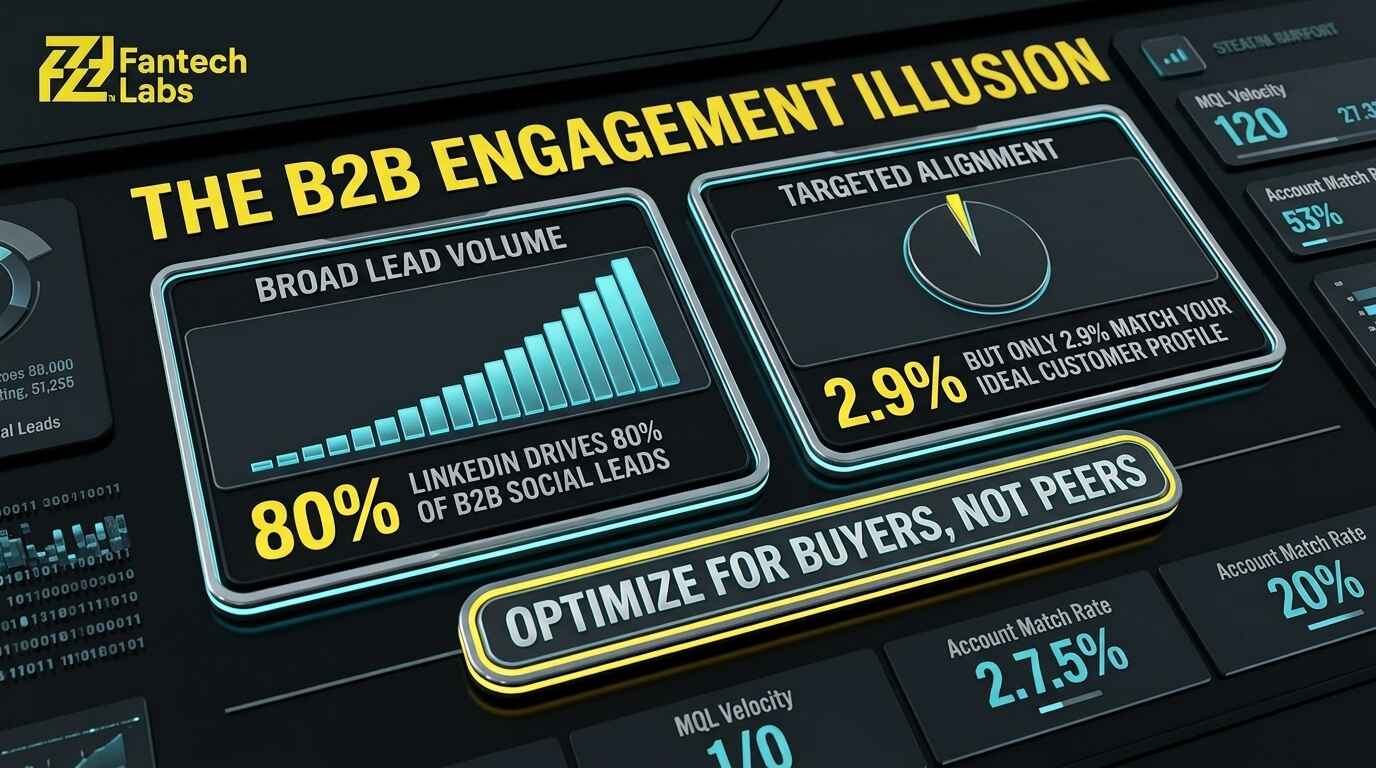
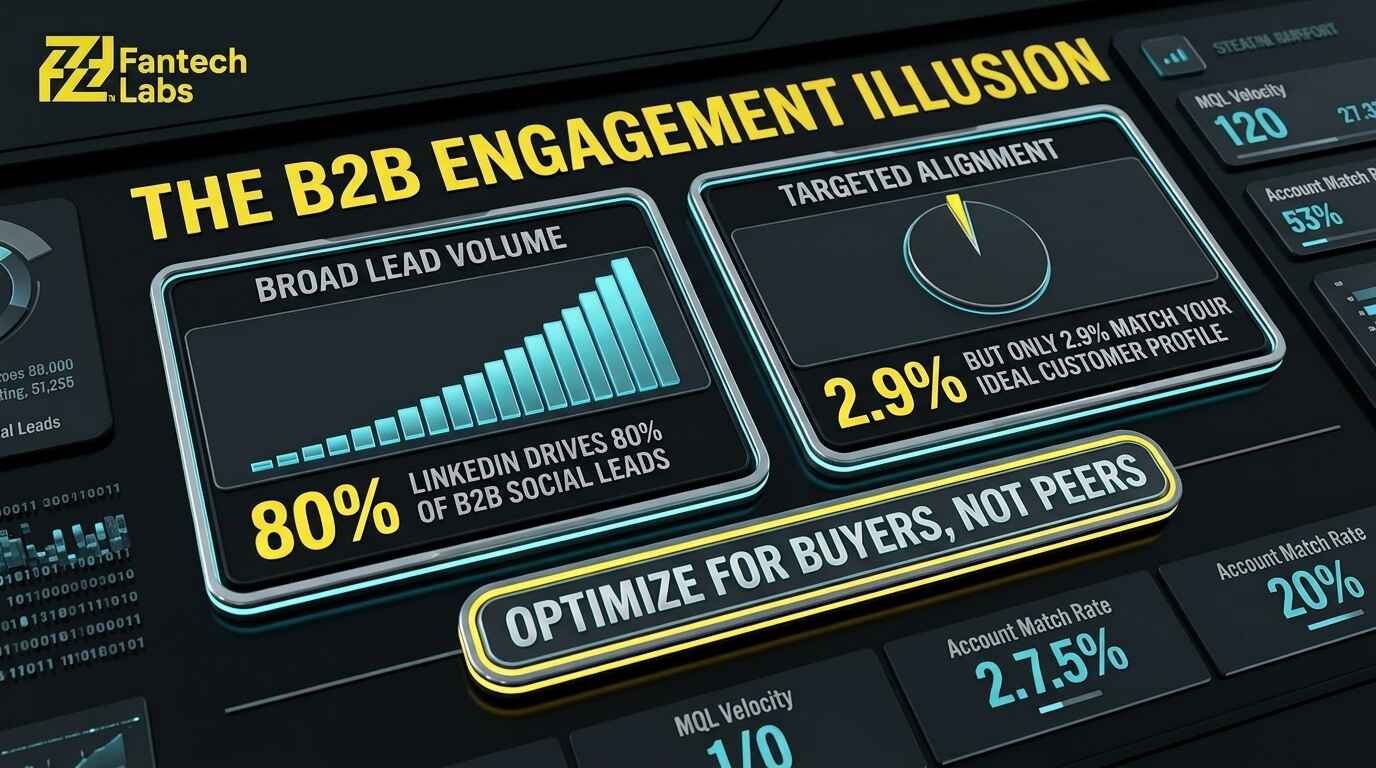
- LinkedIn drives roughly 80% of all B2B social leads, but most of that engagement is worthless. One dataset of nearly 8,000 LinkedIn engagements found only 2.9% came from people who actually match a typical ideal customer profile.
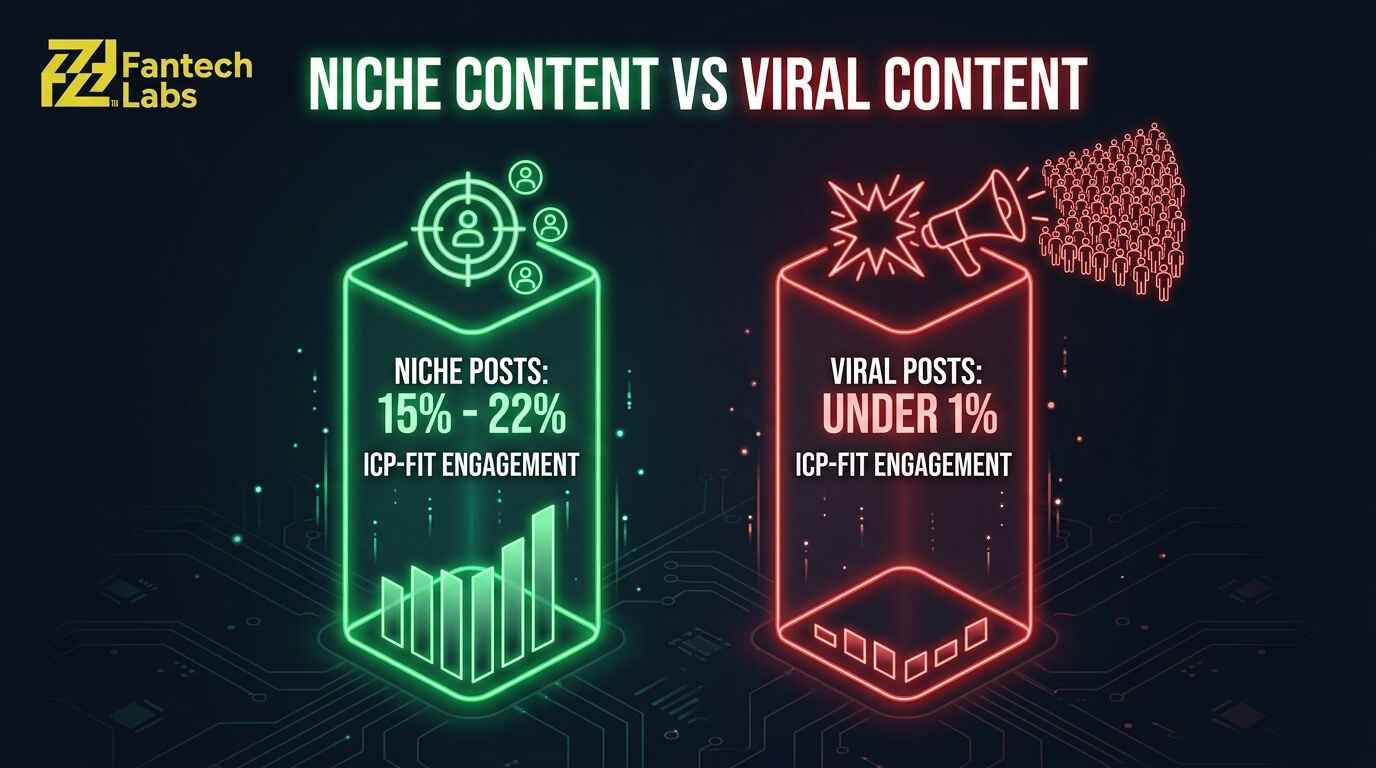
- Niche, specific content converts far better than broad content. Posts built around a real, narrow problem pull 15-22% ICP-fit engagement. Viral or generic posts pull under 1%.
- Meta isn't a B2B lead source. It's a retargeting and brand-reinforcement channel that keeps you visible to people already evaluating you.
- Companies that blog consistently are roughly 13 times more likely to see positive marketing ROI, and B2B companies with active blogs generate meaningfully more leads than those without one.
- Most B2B social programs fail because they're built to please everyone. The ones that generate pipelines are built to repel everyone except the buyer.
WHY MOST B2B SOCIAL STRATEGIES DON'T GENERATE LEADS
Post consistently. Grow followers. Watch the engagement numbers climb. That's the B2C playbook, and most B2B marketing teams run it anyway, then wonder why none of it shows up in the CRM.
Here's the actual problem. LinkedIn produces roughly 80% of all B2B leads that come from social media, and one recent study analyzing close to 8,000 LinkedIn engagements across dozens of B2B founders found that only 2.9% of those engagements came from ICP-fit prospects. Everyone else liking, commenting, and sharing is a peer, a competitor, or someone with no buying authority at all.
A post with 500 likes from people at other marketing agencies is noise. A post with 30 likes, twenty of them from procurement directors at manufacturing firms, is signal. Most reporting dashboards can't tell the difference, which is exactly why most B2B social strategies keep optimizing for the wrong number.
The brands generating real pipelines made one deliberate choice: every piece of content gets built for the specific buyer, not the average LinkedIn scroller. This guide breaks down what that looks like across LinkedIn, Meta, and content strategy, using the benchmarks that separate what works from what just looks good in a monthly report.
LINKEDIN IS THE ONLY B2B CHANNEL THAT MOVES PIPELINE DIRECTLY
LinkedIn isn't one option among several social channels for B2B. It's the channel, and everything else is a supporting player. The platform's edge comes down to targeting: job title, seniority, industry, company size, all filterable, all precise, in a way no other social network offers a B2B seller.
Industry surveys put LinkedIn usage among B2B marketers somewhere in the high 80s to high 90s as a percentage, and the platform consistently converts visitors to leads at roughly three times the rate of Facebook or X. If a B2B brand only has budget and attention for one social channel, this is the one that earns it.
The Organic Strategy That Actually Generates Leads
Write for your ideal buyer, not for your peers. That's the entire principle behind organic LinkedIn content that converts.
Niche industry content, built around a specific and often unglamorous problem, pulls a 15-22% ICP-fit engagement rate. Viral or generic content pulls under 1%, according to the same 7,793-engagement dataset referenced above. A post titled "the future of marketing" attracts marketers. A post titled "why MuleSoft implementations fail in year two" attracts the IT directors and integration architects who actually buy MuleSoft implementation work. The second post gets a fraction of the likes. It also generates real leads, which the first one won't.
Here's roughly how different content types perform for ICP-fit engagement:
| Content Type | ICP-Fit Engagement Rate | Why It Works |
|---|---|---|
| Niche industry insight (specific, opinionated) | 15-22% | Attracts exactly the people who have that problem |
| Case study with real metrics and named client type | 12-18% | Decision-makers see their own situation reflected back |
| Contrarian take on standard industry practice | 10-16% | Pulls practitioners who disagree into the comments |
| Process breakdown ("how we actually handle X") | 10-15% | What buyers want before they'll take a call |
| Original data or research specific to your niche | 8-14% | Shared by practitioners into networks of more practitioners |
| Generic thought leadership | Under 2% | Attracts peers, not buyers |
| Motivational or viral content | Under 1% | Vanity engagement only |
Posting Frequency Matters Less Than People Think
Nearly 70% of LinkedIn users interact with brand content at least weekly, which means the platform rewards being reliably present, not being everywhere. Three posts a week of genuinely useful, niche content will outperform seven posts a week of generic filler on every measure that matters. The algorithm in 2026 weights dwell time and substantive comments over quick reactions, so a post that gets three long, disagreeing comments from senior people in your target industry is doing more work than one that gets three hundred thumbs-up reactions from nobody in particular.
Personal Profiles Beat Company Pages, Full Stop
Company page reach on LinkedIn has been declining since 2022, and personal profiles from founders and senior practitioners consistently outperform them for both reach and ICP-fit engagement. A post from the founder of a Calgary systems integrator will reach more qualified buyers than the same content posted from the company page.
That doesn't make the company page useless. It's where a prospect goes to check you're legitimate before a call, and it's the audience LinkedIn Ads can retarget once someone's visited it. It's just not where organic lead generation happens anymore. If a B2B brand has budget for one thing before the company page, it's getting a founder or senior practitioner comfortable posting under their own name.
LinkedIn Ads: When Paid Actually Earns Its Cost
LinkedIn Ads are expensive on a per-click basis compared to Meta or Google. Across recent 2026 benchmarks, CPCs typically land somewhere between $5 and $16, with competitive B2B verticals like tech and finance pushing well past that. The premium buys audience quality. A click from a VP of Operations at a 500-person manufacturer is worth more to a B2B services firm than a click from someone scrolling Instagram on their lunch break, even if the second click cost a fraction as much.
| Lead Gen Forms | Bottom-of-funnel offers, gated content | Conversion rates vary by source, roughly 3-10% depending on offer and targeting |
|---|---|---|
| Thought Leader Ads | Amplifying a founder or executive's content | Often the most cost-efficient format on the platform |
| Sponsored Content (single image) | Awareness and mid-funnel visibility | CTR typically under 1%, which is normal for the format |
| Message Ads (InMail) | Direct outreach to named decision-makers | Response rates vary widely, commonly cited in the 10-25% range |
| Conversation Ads | Multi-step nurture sequences | Tends to outperform a single static message |
| Document Ads | Gating reports, frameworks, playbooks | A strong format specifically for lead capture |
A useful rule of thumb for a first LinkedIn Ads test: don't bother below a few thousand dollars a month in spend. Below that threshold, there usually isn't enough data volume to optimize meaningfully. A reasonable starter split puts roughly half the budget into Sponsored Content for awareness and half into Lead Gen Form campaigns for bottom-of-funnel conversion, then shifts weight toward whichever is actually producing pipeline after 60 days.
META'S ROLE IN B2B: SUPPORTING PLAYER, NOT LEAD SOURCE
Meta doesn't generate cold B2B leads at scale. Say that out loud before building a Meta budget, because expecting otherwise is how B2B teams waste money on the platform.
What Meta actually does well in a B2B context is keep a brand visible to people who are already warm. Someone who spent four minutes on your case studies page is a real prospect. Retarget them on Meta for the next month with a relevant testimonial or related case study, and you're staying in consideration through a buying cycle that, in B2B, often runs for months.
A few places Meta earns its budget:
Retargeting website visitors and LinkedIn engagers, which keeps a brand top of mind during a long evaluation window.
Lookalike audiences built from an existing client list, uploaded into Meta Ads Manager. This tends to work better for reaching business owners and entrepreneurs than corporate decision-makers, who are more reliably found on LinkedIn.
Event and webinar promotion, where competition for that specific objective is often lower on Meta than on LinkedIn, which can bring the cost per registration down.
Amplifying already-proven content. If a LinkedIn post or blog article performed well organically, boosting it to a Meta audience builds familiarity before a prospect ever reaches the buying stage.
CONTENT IS THE ENGINE, NOT A SOCIAL TACTIC
A social strategy without content behind it is a distribution plan with nothing to distribute. Marketers who prioritize blogging are roughly 13 times more likely to see positive marketing ROI, and B2B companies that blog consistently generate meaningfully more leads than those that don't. LinkedIn posts, Meta retargeting, and LinkedIn Ads all perform better when they point back to something substantive: a case study, a technical guide, an original piece of research.
| Content Type | Lead Gen Value | Distribution Channel |
|---|---|---|
| Original research with proprietary data | Very high | LinkedIn, email, press |
| Detailed case studies with specific metrics | Very high | Website, LinkedIn, sales outreach |
| Comparison guides (your approach vs. alternatives) | High | Organic search, LinkedIn |
| Technical implementation guides | High | Organic search, LinkedIn, email |
| ROI calculators and frameworks | High | Website landing page, LinkedIn |
| Webinars and recorded demos | High | LinkedIn, email, YouTube |
| Opinion pieces on industry trends | Medium | LinkedIn thought leadership |
| Generic "tips and tricks" content | Low | Drives engagement, not leads |
Building Around Content Pillars
Random posting doesn't compound. B2B brands that generate consistent leads build content around three to five pillars tied directly to specific buyer pain points, then map every piece, whether it's a LinkedIn post, a blog article, or a case study, back to one of those pillars.
For a firm like Fantech Labs, that might look like integration failure patterns, automation ROI measurement, data governance in complex environments, and AI readiness for mid-market companies. Every post moves the reader one step from "I have this problem" toward "this firm clearly knows how to solve it."
MEASURING SOCIAL ROI: WHAT MATTERS AND WHAT TO IGNORE
Follower growth, impressions, and engagement rate tell a marketing team how visible its content is. They tell the CEO nothing about revenue, which is the only question that actually matters at budget renewal time.
| Metric | What It Measures | How To Track |
|---|---|---|
| ICP-fit engagement rate | Share of engagement from target accounts | Manual review or LinkedIn Sales Navigator |
| Profile visits from target companies | Awareness among decision-makers at key accounts | LinkedIn analytics, filtered by company |
| Content-attributed pipeline | Deals where social content was in the buyer's journey | HubSpot or Salesforce with UTM tracking |
| Social-sourced leads | Leads whose first touch was social | CRM source attribution |
| Cost per qualified lead (paid) | LinkedIn Ads spend divided by qualified leads | LinkedIn Campaign Manager plus CRM |
| Time-to-close for social-sourced leads | Whether social leads convert faster or slower | CRM pipeline report |
For pure cost-per-lead comparisons, SEO, email, and webinars tend to come in well below LinkedIn Ads, commonly cited somewhere around $30 for SEO, $50 for email, and $70 for webinars against LinkedIn's considerably higher per-lead cost. LinkedIn still frequently wins on cost per closed deal, because the seniority and buying intent of the leads it produces tends to be higher. HubSpot's attribution reporting, connected to LinkedIn Campaign Manager, is the most reliable way to see that multi-touch influence rather than crediting only the last click.
A 90-DAY B2B SOCIAL LAUNCH PLAN
Days 1-30, Foundation. Get specific about the ICP: industry, company size, job title, and the exact pain point your service solves. Audit existing LinkedIn content for anything that already generated ICP-fit engagement, even accidentally. Set three to five content pillars tied to real buyer pain points. Get LinkedIn Analytics and HubSpot UTM tracking running before publishing anything new.
Days 31-60, Content and Testing. Publish three posts a week from a founder or senior practitioner, not the company page. Rotate through a niche industry insight, a process breakdown, and a case study or client result each week, and track which format actually pulls ICP-fit comments, not just total reactions. Write and publish two long-form blog articles targeting the commercial keywords your buyers are actually searching.
Days 61-90, Amplify What's Working. Take the two or three posts with the strongest ICP-fit engagement and put a modest paid budget behind them to extend reach into the target audience. Launch a Meta retargeting campaign aimed at website visitors, using the best-performing case study as the creative. Start building a Sales Navigator list of the ICP-fit prospects who engaged organically, and reach out to them directly, referencing the specific content they engaged with.
FREQUENTLY ASKED QUESTIONS
What is the most effective social platform for B2B lead generation in 2026?
LinkedIn, by a wide margin. It produces somewhere around 75-85% of all B2B leads that come from social media and converts visitors to leads at roughly three times the rate of any other platform. For a B2B brand with limited social budget, LinkedIn is the one channel that consistently justifies direct investment as a lead generation tool. Everything else plays a supporting role in awareness or retargeting.
How often should a B2B brand post on LinkedIn?
Less often than most teams assume, and with more specificity. Three posts a week of niche, ICP-specific content outperforms daily posting of generic content, and nearly 70% of LinkedIn users interact with brand content weekly anyway. Posting from a founder's or executive's personal profile consistently beats posting from the company page for both reach and qualified engagement.
Does Meta work for B2B lead generation?
Not as a primary source of cold leads, but it's genuinely useful in a supporting role. Meta's strongest B2B applications are retargeting website visitors and LinkedIn engagers during a long buying cycle, building lookalike audiences from an existing client list, and promoting webinars at a lower cost per registration than LinkedIn often allows. Expecting cold B2B leads at scale from Meta leads to wasted budget. Expecting brand visibility during an evaluation period is realistic and achievable.
How do you measure social media ROI for a B2B brand?
Through pipeline attribution, not vanity metrics. The metrics that actually matter are ICP-fit engagement rate, social-sourced leads tracked at the CRM level, content-attributed pipeline through multi-touch attribution tools like HubSpot, and cost per qualified lead from paid campaigns. Follower counts and average engagement rates are fine for benchmarking content performance, but they should never be the headline number in a conversation about social ROI with leadership.
What type of content generates the most B2B leads on LinkedIn?
Content built around a specific, narrow problem, not content built to appeal broadly. Niche industry posts pull a 15-22% ICP-fit engagement rate, while viral or generic content pulls under 1%. The formats that consistently produce qualified leads are case studies with real, measurable outcomes, niche insights that reflect genuine hands-on expertise, process breakdowns that show exactly how a firm solves a specific problem, and contrarian takes that pull practitioners into the comments. Content designed to please everyone tends to convert no one who actually buys.
SUMMARY
B2B social media works when it's built around one buyer at a time, not around what gets the most likes. LinkedIn does the heavy lifting for lead generation. Meta keeps a brand visible while a deal is being evaluated. Content is what makes either channel worth anything at all. The brands that treat ICP-fit engagement, not follower count, as the real scoreboard are the ones that turn social media into a pipeline instead of a monthly vanity report.
WHY TRUST THIS CONTENT
Fantech Labs is a Calgary-based digital marketing and IT services firm that builds and runs B2B social, SEO, and content programs for clients across Canada and the USA. The recommendations above come from work run and measured against actual pipeline outcomes, not just platform-reported engagement metrics.
DISCLAIMER
This guide reflects general industry benchmarks and platform data available as of 2026. Statistics on engagement rates, ad costs, and lead generation performance vary by industry, audience, and campaign execution, and cited figures should be treated as directional ranges rather than guarantees for any specific business. A few of the widely repeated figures above (LinkedIn's 80% B2B lead share, InMail response rates, and the SEO/email/webinar cost-per-lead numbers) circulate across marketing-stats aggregator sites without one traceable primary source, so treat them as directional industry consensus rather than audited numbers, and verify before using in a client-facing claim or ad. Talk to our digital marketing team to discuss a strategy built around your actual numbers.
Author Bio
Rehan Javed is a B2B Growth Strategist at Fantech Labs, specializing in pipeline-driven social media and content marketing. With a focus on LinkedIn organic growth and precision paid acquisition, Rehan helps North American B2B brands stop optimizing for vanity metrics and start building digital strategies that generate qualified leads and closed revenue.